What You'll Learn in this Post
- GEO is not new, it is SEO principles applied to AI driven discovery.
- Clear structure, credibility, and usefulness still win.
- AI favors coherence, corroboration, and intent over volume.
- Expect less traffic, better fit, stronger conversations.
- Panic is misplaced. AI compresses journeys, it does not erase them.
- This is a moment to clean up content and strategy anyway.
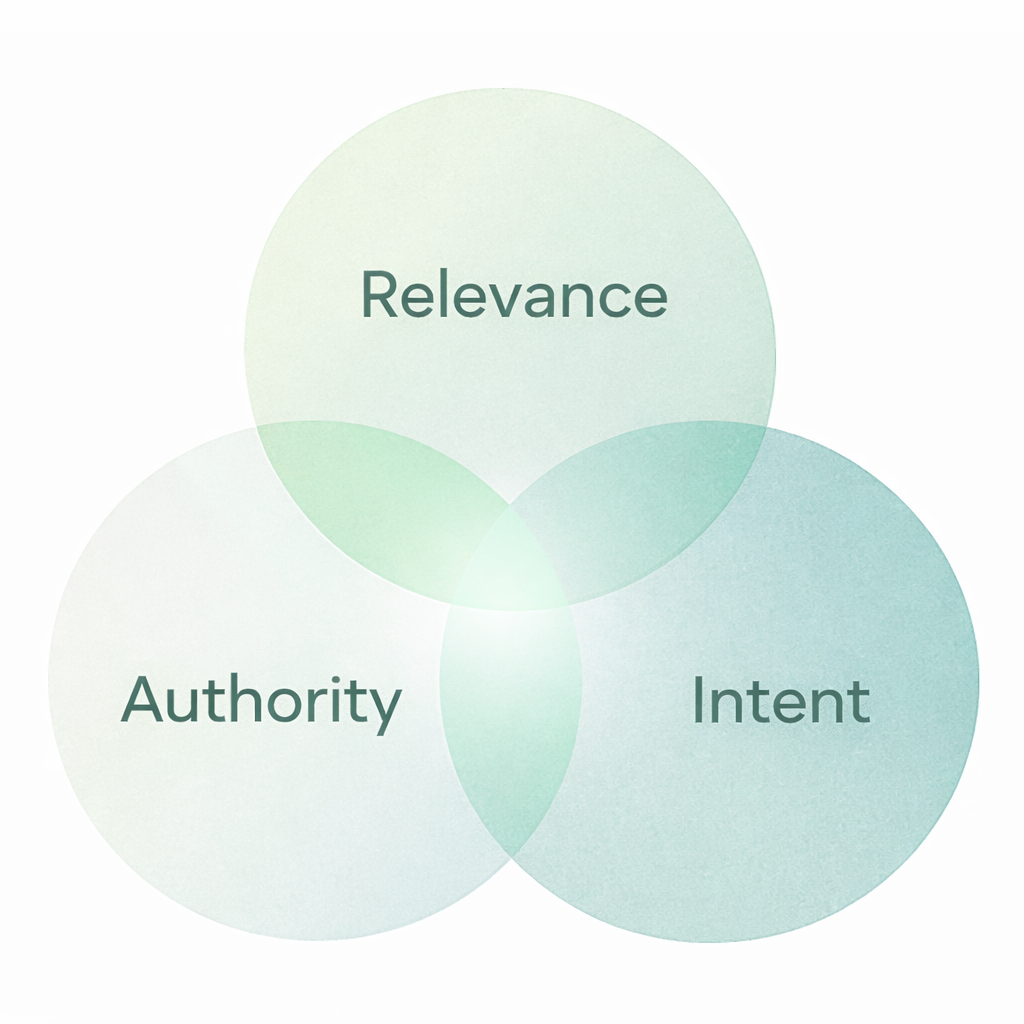
- Focus on relevance, authority, and intent and GEO takes care of itself.
Every few years, our industry finds a new phrase to describe an old responsibility.
Generative Engine Optimization, often shortened to GEO, is the latest entrant. You will also hear it described as AI Optimization, AI Search Optimization, or Answer Engine Optimization. Different labels, same underlying concern.
How do we ensure our thinking, our expertise, and our offerings are discoverable when machines increasingly sit between curiosity and action?
That question feels urgent. It feels disruptive. It also feels strangely familiar.
What Generative Engine Optimization Actually Is
GEO is the equivalent of SEO, but applied to improving your website for discovery in an AI query.
At its core, GEO is the practice of making your content legible, trustworthy, and useful to generative AI systems that summarize, recommend, and direct attention. These systems do not simply index pages. They interpret meaning, assess credibility, and synthesize answers.
That might sound novel. The mechanics are new. The intent is not.
Search engines have always been proxies for human judgment. GEO simply shortens the distance between interpretation and response.
Why This Is Not New
If you have ever taken SEO seriously, none of this should feel foreign.
The foundational principles remain intact.
- Clear structure
- Consistent topical focus
- Demonstrated expertise
- Credible signals from outside your own walls
- Content designed to be genuinely helpful
These are not AI inventions. They are the accumulated lessons of decades spent trying to align content with human need.
Google itself has reinforced this continuity. Its long standing emphasis on experience, expertise, authority, and trust remains central to how content is evaluated, whether the consumer is a person or a machine. You can see this directly in Google’s published guidance on helpful content and quality signals
https://developers.google.com/search/docs/fundamentals/creating-helpful-content
GEO does not replace SEO. It extends it.
Why This Is New
What has changed is how signals are weighted and how quickly conclusions are formed.
Generative systems prioritize a few subtle but meaningful qualities.
- They favor coherence over volume.
- They reward specificity over generality.
- They value corroboration, not proclamation.
AI models are less impressed by pages that try to rank for everything. They are more confident in sources that demonstrate a sustained, consistent point of view.
Context matters more. Structure matters more. The relationship between questions and answers matters more.
This is not about tricking a model. It is about making your intent unmistakable.
Validation from Neil Patel
At the Progress MartechNEXT conference, I had a chance to test Flywheel's thinking with one of the preeminent thinkers in this space. Of course, he agrees with me ;)...
(2 min, 8 seconds)
How Success Looks Different
One of the most uncomfortable truths about GEO is also one of the healthiest.
- Traffic quantity often declines.
- Traffic quality almost always improves.
You may see fewer visits from casual browsers. You may see fewer one page sessions. What you should see is more relevance in the conversations that remain.
- Visitors arrive with more context.
- They stay longer.
- They convert with less friction.
In other words, the people who find you are more likely to need you.
That is not a loss. That is alignment.

A Necessary Caution About Fear
There is a narrative forming that suggests everyone is about to be left behind.
Pause for a moment.
If SEO was never treated as a strategic priority inside your organization, why would GEO suddenly become an existential threat? The anxiety often has less to do with AI and more to do with long deferred discipline.
It is also worth noting that current research suggests AI tools are not replacing search behavior as much as they are reshaping it. Users still validate, still click through, still seek confirmation. AI frequently deflects early stage exploration, not considered decision making.
In many cases, AI is compressing the journey, not eliminating it.
Which means your content still matters. Possibly more than before.
An Opportunity Disguised as Disruption
If you are thinking about GEO, that is a good sign.
This moment creates permission to do the work that has quietly needed doing for years.
- Clarifying your message.
- Tightening your content.
- Aligning your go to market strategy with how buyers actually think and behave.
For some teams, this may be the rare moment where content quality, audience focus, and long term strategy find internal allies at the same time. Use it.

How We Approach GEO at Flywheel
We do not chase algorithms. We do not hack our way to visibility.
We anchor these conversations in deliberate, strategic focus built around three pillars.
1. Relevance
We begin with a structured understanding of your audience and who you need to engage. Not everyone. The right people, the right way.
Adding clarity, structure and intention here will determine direction. It informs tone, depth, and emphasis. Without it, optimization is guesswork.
2. Authority
Saying the right thing is not enough. You must say it in a way that is useful, credible, and substantiated by how you operate and what you deliver.
Authority is not broadcast. It is earned.
That still includes external validation. Citations, partnerships, references, and backlinks remain critical signals. AI systems look for consensus and corroboration, not isolated claims.
3. Intent
Helping visitors accomplish their task is non negotiable.
A click followed by confusion is still a failure signal. A bounce back to the engine, human or generative, suggests misalignment.
You need to understand what your audience is trying to do, not what you wish they would discover.
When intent is respected, both SEO and GEO fall into place naturally.
The Outcome
Follow this approach and you do more than optimize for machines.
You attract better conversations.
You earn attention instead of chasing it.
You build visibility that compounds rather than decays.
Generative Engine Optimization is not a fork in the road. It is a reminder.
The fundamentals still win.
Work with Flywheel
Of course, we're happy to guide you through this! Get in touch.